
Mosque guide · Kufa, Iraq
Great Mosque of Kufa
مسجد الكوفة المعظم
- Directions: we have not verified an exact map pin yet, so show a driver the Arabic name under “When you arrive”.
- Ziyarat: no checked text is published for this site yet.
If you are new to this
The Great Mosque of Kufa is one of the oldest mosques in Islam. Imam Ali (as) prayed and taught here while Kufa was his capital, and he was fatally struck here during the dawn prayer in 40 AH. Inside are several “stations” (maqamat), places associated with Prophets and Imams, where visitors pray. The shrines of Muslim ibn Aqil and Hani ibn Urwa stand beside it.
On this page
Part 1
Understand
Why this mosque matters, and what the stations inside it are. Each statement is labelled so you can tell established history from religious belief.
How to read this guide
Each statement is labelled so you can tell what kind of information it is.
- Historical record
- Widely documented in historical sources.
- Shia belief
- Religious belief held in the Twelver Shia tradition.
- Accounts differ
- Sources disagree. We note this openly.
- Practical
- Visitor logistics. These can change.
An early mosque
Kufa was founded as a garrison town in the early decades of Islam, and its mosque dates from that period. Imam Ali (as) made Kufa his capital, and prayed and taught in this mosque. [Moojan Momen] [al-Shaykh al-Mufīd]
Imam Ali (as) was struck here during the dawn prayer in Ramadan 40 AH. The place is marked by the mihrab of Amir al-Muʾminin. [al-Shaykh al-Mufīd] [Amānat Masjid al-Kūfa al-M…]
Read the full history and significanceThe stations (maqamat)
The stations (maqamat)
Shia tradition associates particular places in the mosque with Prophets and with Imam Ali (as). The mosque administration marks stations including the mihrab of Amir al-Muʾminin, the station of the angel Jibraʾil at the fifth column, and the station of the Prophet Ibrahim at the seventh column. [Amānat Masjid al-Kūfa al-M…]
Devotional sources describe recommended prayers and supplications at each station. Because these differ in detail between editions, we do not reproduce them yet. [Shaykh ʿAbbās al-Qummī]
Part 2
Before you go
Religious obligations, recommended practices, shrine rules and general etiquette are listed separately. Recommended acts are encouraged, not required.
Recommended devotional acts
These acts are described in devotional sources as recommended (mustahabb). They are not obligatory.
Performing ghusl (ritual bathing) for ziyarat before visiting. [Shaykh ʿAbbās al-Qummī]
Approaching with humility, and reciting the words asking permission to enter (idhn al-dukhul) before going in. [Shaykh ʿAbbās al-Qummī]
Offering prayers at the stations (maqamat) of the mosque, as described in devotional sources. [Shaykh ʿAbbās al-Qummī]
Religious obligations
Ziyarat does not suspend everyday obligations such as daily prayers and modesty. The specific rulings depend on the scholar (marjaʿ) you follow, so check their published guidance for questions such as prayer for travellers.
Venue rules
Security checks operate around the shrines. Rules on entrances, bags, phones and clothing are set by the mosque administration and can change. Follow the instructions of shrine staff and security personnel, use the designated entrances and allow extra time during busy periods.
General etiquette
Dress modestly and move quietly. Give way to people who are praying, elderly visitors and families. Be careful with photography, especially of other visitors.
Questions of religious law depend on the scholar you follow (your marjaʿ). If you are unsure, please ask a qualified scholar.
Security, etiquette, accessibility and facilitiesWhat to expect on site, and who to ask
Security and facilities
Security checks operate around the shrines. Follow the instructions of shrine staff and security personnel and any posted signs, use the designated entrances and allow extra time during busy periods.
Facilities such as toilets, shoe storage, drinking water and step-free routes differ from site to site and between entrances. We have not verified them for each location, so please ask shrine staff on arrival.
Accessible routes and facilities can vary by entrance and by crowd arrangements on the day. Ask shrine staff for assistance on arrival.
Etiquette on site
Dress modestly, move quietly, and give space to people praying at the stations. [Ziyarat Guide]
Accessibility
Accessible routes and facilities can vary by entrance and by crowd arrangements on the day. Ask shrine staff for assistance on arrival.
Visiting with family
We do not have confirmed details for this yet. Please ask shrine staff on arrival.
Facilities
Facilities such as toilets, shoe storage, drinking water and step-free routes differ from site to site and between entrances. We have not verified them for each location, so please ask shrine staff on arrival.
Part 3
When you arrive
Arrangements on site can change, so follow the instructions of shrine staff and confirm anything important on arrival.
Show this to a driver
مسجد الكوفة المعظم
Masjid al-Kūfa al-Muʿaẓẓam
Spelling checked against Amānat Masjid al-Kūfa al-Muʿaẓẓam (Secretariat of the Great Mosque of Kufa and its shrines), official website, masjed-alkufa.com, accessed 14 October 2026. on 2026-10-14.
Map
We have not confirmed an exact pin yet, so we link to a map search rather than a fixed point.
Search for it on OpenStreetMapGetting there
Kufa is close to Najaf, and many visitors combine the two. We have not yet sourced reliable journey times. (source needed)
Nearby
The shrines of Muslim ibn Aqil and Hani ibn Urwa adjoin the mosque. The house of Imam Ali (as) stands about 100 metres away. [Amānat Masjid al-Kūfa al-M…]
Part 4
During your visit
Prayers recited at the mosque. Show or hide each available layer, change the text size, or read full screen. We only publish a text after checking it against a named edition.
We have not yet added a devotional text for this mosque. A text will appear here once it has been checked against a named edition.
Part 5
Reflect
Themes many visitors reflect on here. You do not need any background knowledge to use them.
Questions to take with you
- What distracts me most during prayer, and what could I change?
- What have I received from earlier generations that I take for granted?
Themes for reflectionPrayer · Continuity
Prayer
Imam Ali (as) was struck while leading prayer, and the mosque is still, first of all, a place of prayer. Consider the place prayer has in your own day.
Continuity
People have prayed on this ground for well over a thousand years. Think about what you have inherited from those before you, and what you will pass on.
Part 6
Continue your journey
Sites often visited on the same trip, and further reading.
Shrine · Kufa
Shrine of Muslim ibn Aqil (as)
The resting place of Muslim ibn Aqil, Imam Hussain’s (as) envoy to Kufa, who was killed there in 60 AH. It adjoins the Great Mosque of Kufa.
Full guideShrine · Kufa
Shrine of Hani ibn Urwa
The resting place of Hani ibn Urwa, who sheltered Muslim ibn Aqil, Imam Hussain’s (as) envoy, and was killed in Kufa in 60 AH. It is beside the shrine of Muslim ibn Aqil, within the Great Mosque of Kufa complex.
Summary only, full guide comingShrine · Kufa
Shrine of al-Mukhtar al-Thaqafi
The resting place of al-Mukhtar al-Thaqafi, who led an uprising in Kufa after Karbala to avenge Imam Hussain (as). It is within the Great Mosque of Kufa complex.
Summary only, full guide comingHistoric site · Kufa
House of Imam Ali (as)
The house in Kufa associated with Imam Ali (as) during his caliphate. It is about 100 metres from the Great Mosque of Kufa and is visited as a separate site.
Summary only, full guide coming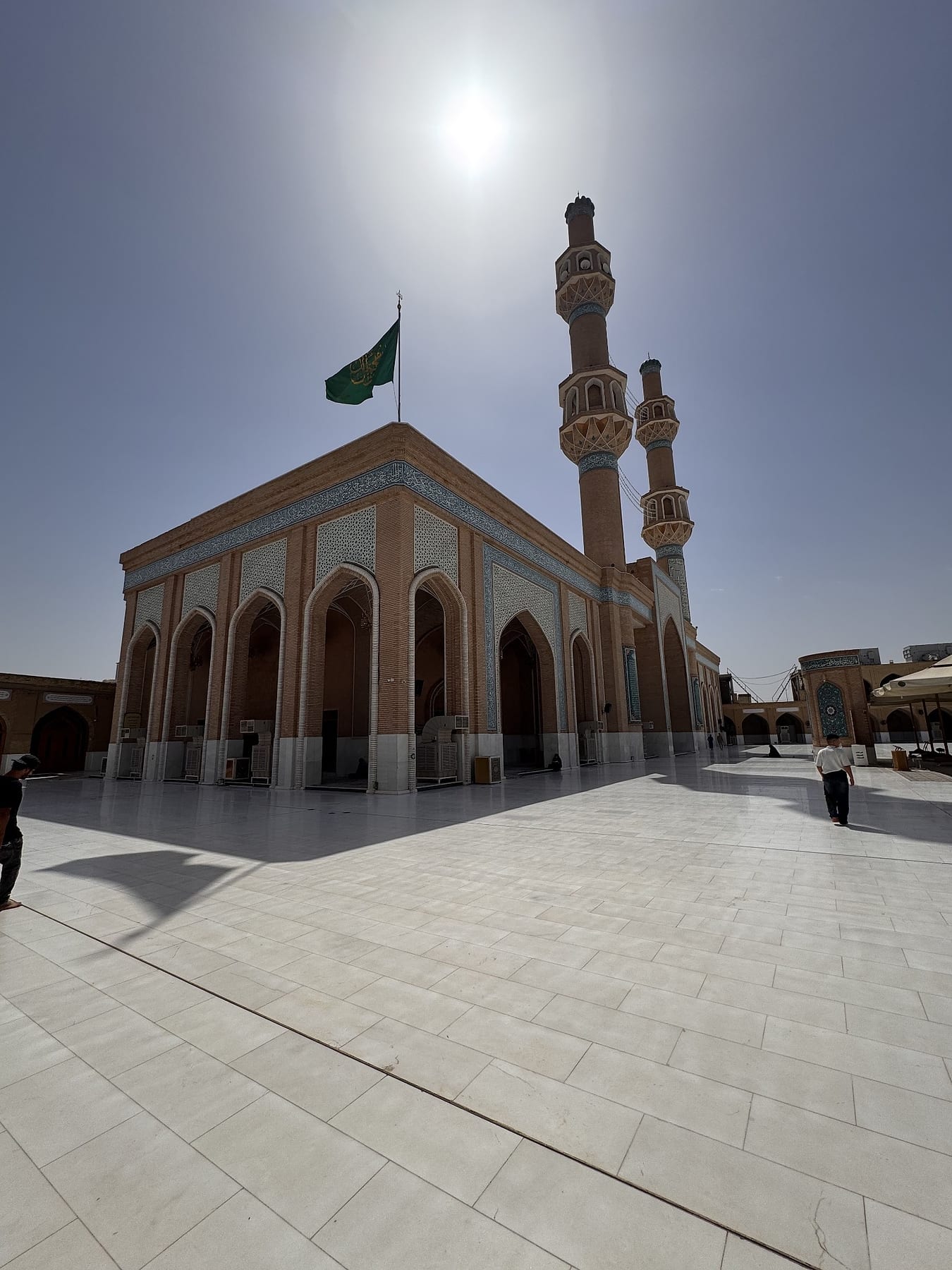
Mosque · Kufa
Masjid al-Sahla
A first-century mosque about two kilometres north-west of the Great Mosque of Kufa. Shia tradition holds that prophets prayed here, and narrations attributed to Imam al-Sadiq (as) describe it as the place where Imam al-Mahdi (ajtf) will reside after his reappearance. A station (maqam) within it is attributed to him.
Summary only, full guide coming
Sources
Written by A humble human
Sources referred to
- al-Shaykh al-Mufīd, Kitāb al-Irshād: The Book of Guidance into the Lives of the Twelve Imams, trans. I. K. A. Howard (London: Balagha Books & Muhammadi Trust, 1981).
- Moojan Momen, An Introduction to Shiʿi Islam (New Haven: Yale University Press, 1985).
- Amānat Masjid al-Kūfa al-Muʿaẓẓam (Secretariat of the Great Mosque of Kufa and its shrines), official website, masjed-alkufa.com, accessed 14 October 2026.
- Shaykh ʿAbbās al-Qummī (d. 1359 AH), Mafātīḥ al-Jinān.
Spotted an error? Let us know. You can also read how we check content.